BRACE scientists awarded funding for innovative dementia research
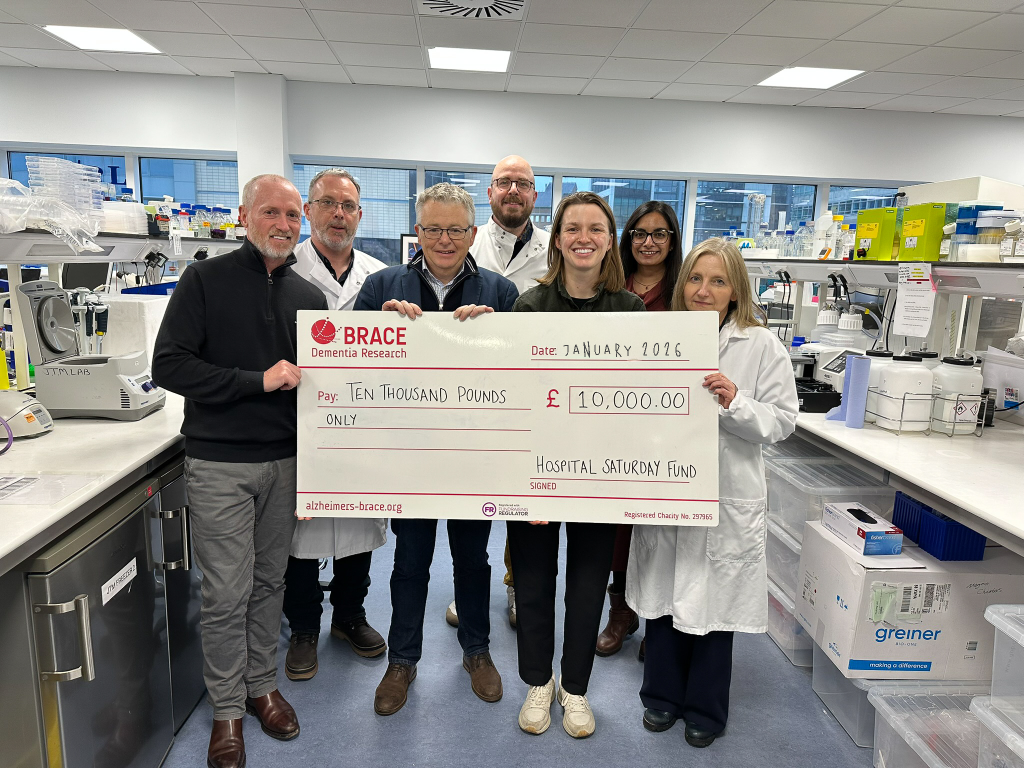
The Hospital Saturday Fund have awarded £10,000 to support a groundbreaking study into brain ageing and genes that could advance drug development. This donation bolsters a grant of £56,000 from BRACE Dementia Research.
Dr James Murray and his team believe a new approach could address a major problem: why promising dementia drugs keep failing in clinical trials.
Why current research models fall short
Most drug development models use mice or rats to study dementia, but Dr Murray believes those models are flawed, as mice and rats do not naturally develop dementia like humans. This means that drugs developed on these kinds of animals might not work in the same way in humans.
Why use animal models?
Scientists use animal models only when absolutely necessary, and the research is expected to yield findings that benefit both humans and animals.
Animals are used in this research because:
- They share similar genetics with humans
- Their biology shows how dementia and related diseases develop and progress
- Using only human or animal cells will not show how the living body responds to dementia and treatments
A better model for testing treatments
Dr Murray's team is developing a new research model using Turquoise Killifish (Nothobranchius furzeri) - small fish with a naturally short life span of only a few months, that age rapidly, and naturally develop physical characteristics associated with dementia. The research aims to edit specific Killifish genes to develop memory and thinking problems similar to human dementia, offering a more accurate way to develop and test dementia drugs.
The grant enables the Swansea team to pursue this innovative approach as part of a pilot project.
Swansea University is one of only a few UK laboratories pioneering this approach. While immediate treatments will not emerge from this project, Dr Murray hopes it will create a valuable research model that could ultimately lead to breakthroughs helping millions of people affected by dementia around the world.
Dr James Murray says:
"We hope this model will help researchers design drugs that actually work when they reach patients. The Hospital Saturday Fund's £10,000 award is crucial in allowing us to take this next step. Combined with BRACE Dementia Research's significant support, we can pursue research that could transform our understanding of dementia and how we tackle it.”
A spokesperson from The Hospital Saturday Fund:
“The Hospital Saturday Fund were delighted to award a £10,000 grant to support an exciting pilot project at Swansea University.
The project aims to develop the African Turquoise Killifish as a new model organism for studying dementia, taking advantage of the species’ exceptionally short life cycle.
If successful, this research could enable more efficient testing of potential treatments and significantly deepen our understanding of dementia, an essential step toward improving outcomes for those affected.”
Liberty Harrison, interim CEO from BRACE Dementia Research adds:
"Dr Murray's innovative approach could offer a new model that unlocks new ways to tackle dementia. With almost 1 million people living with dementia in the UK, this improved understanding of brain ageing could have a meaningful impact.”