
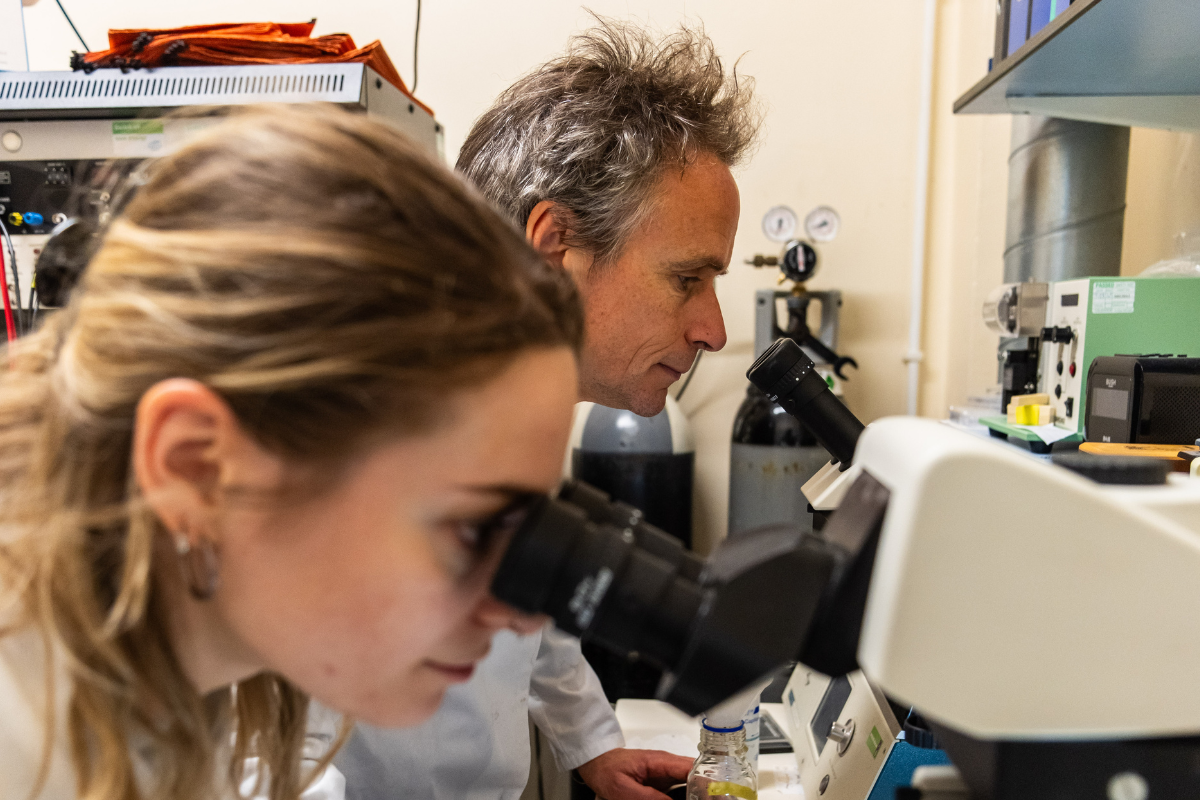
Professor James Hodge
PhD: University of Bristol, 2023 │ PhD Student: Amy Preston
Functional characterisation of deafness, Alzheimer’s and Parkinson’s disease associated ctl2 – choline transporter-like protein 2 (SLCC44A2) as a potential new drug target.
Humans and Flies may not be so different.
Summary
Professor James Hodge, with support from Amy Preston during her PhD and his team, is investigating the link between deafness and Alzheimer’s disease in fruit flies, through a gene called SLC44A2. They hope that this gene could be a target for new treatments.
What do we already know?
Parkinson’s disease and Alzheimer’s disease affect millions of people every year, and at the moment, there are limited treatment options. Over the years, scientists have been able to identify many genes which are linked to these diseases. However, researchers are still not sure how these genes contribute to the progression of Alzheimer’s or Parkinson’s disease, and many of these genes have not been studied in living animals.
One of the genes linked with Alzheimer’s and Parkinson’s is the SLC44A2 gene. Dr Hodge and his team will be using fruit flies to study how these genes effect our brains. These fruit flies have a gene known as choline transporter-like protein 2 (Ctl2) which is equivalent to the SLC44A2 in humans. Fruit flies are often used in research because they have short lifespans and can be studied with a wide range of genetic tools. Previous work by Amy Preston has shown that mutating the fly alternative to the SLC44A2 gene can cause memory loss similar to that which occurs in Alzheimer’s disease.
Mutations in the SLC44A2 gene have also been linked to deafness, a lesser known modifiable risk factor for Alzheimer’s The link between deafness and Alzheimer’s is poorly understood by researchers.
What is this project trying to find out?
In this project Dr Hodge and his research team aim to test whether changes in the Clt2 gene (the SLC44A2 equivalent in fruit flies) can cause deafness, Alzheimer’s or Parkinson’s-like symptoms in fruit flies. They aim to understand the mechanism of how Clt2 causes these symptoms. They will also test whether this gene can be a potential target in the treatment of Alzheimer’s and Parkinson’s.
Why is this important?
If this study is successful, it could lead to a better understanding of the progression of Alzheimer’s and Parkinson’s disease as well differences and similarities between these diseases and their potential relationship to deafness. It may also open a new drug target for the treatment of these conditions. It will also help us improve our understanding of the link between deafness and forms of dementia such as Alzheimer's.
What has been achieved so far?
In the first year of Amy’s PhD, she worked with the research team to set up tools to study the symptoms of Alzheimer’s disease in the flies. They started using a gene-editing method called CRISPR to delete parts the Ctl2 gene in the flies. They did this to find out which parts of the gene contribute to the symptoms of Alzheimer’s disease. They also experimented by reducing the activity of the Ctl2 gene, which resulted in effects like those seen in patients with Alzheimer’s, such as reduced memory and trouble with sleep.
Share this page